Cleaning Your First Apartment: A Weekly Schedule That Actually Works
Nobody moves into their first apartment with a cleaning schedule. What most people move in with is an assumption: “I’ll just clean when things get dirty.” Four months later the shower is unrecognisable, the oven is on fire, and Sunday afternoon is a three-hour cleaning binge you resent.
The trick isn’t cleaning more — it’s cleaning in small, regular bursts so nothing ever accumulates to the point of dread. Fifteen minutes a day, forty minutes a week, and one longer session a month keeps an apartment consistently liveable for less total time than the binge approach.
This is the schedule that actually works. Not aspirational. Realistic.
The schedule at a glance
| Frequency | Time commitment | Purpose |
|---|---|---|
| Daily (5 min) | Every day | Prevent overnight build-up |
| Weekly (40 min) | One block, e.g. Sunday morning | Full surface reset |
| Monthly (60-90 min) | One weekend afternoon | Deep-clean rotation |
| Quarterly (2 hours) | Once every 3 months | The forgotten stuff |
Add it up: ~90 minutes per week of total cleaning for a small apartment kept genuinely liveable. Less than one Netflix episode a day of maintenance.
Daily — the 5-minute habits
These are habits, not tasks. Once they’re automatic you won’t think of them as “cleaning” any more than you think of showering as cleaning.
- Make the bed. Every morning, before you leave the bedroom. Two minutes. The visual impact is completely disproportionate to the effort — an unmade bed makes a whole bedroom read as messy.
- Wash the dishes after each meal. Or fill the dishwasher and run it every night. The delta between “sink of dishes” and “no dishes” is the biggest daily-mood difference in the apartment.
- Wipe the kitchen bench after cooking. Sixty seconds. A wet dishcloth over the whole bench, once, immediately after you finish plating up. Stops grease and food spatter from setting.
- Squeegee the shower after use. If you have a glass shower screen, a $10 squeegee kept in the shower makes soap scum a non-issue. Ten seconds after you turn the water off. Genuinely the single biggest bathroom hack.
- Put things away as you go. Coat on hook, shoes by the door, mail sorted into “action / recycle” the moment you pick it up. Never let a “temporary” pile become a permanent one.
The rule: you don’t have to clean, you just don’t leave things worse than you found them.
Weekly — one 40-minute block
Pick a day and block it. Sunday mornings and Wednesday evenings are the two most popular slots — pick the one you’re least likely to skip. Put on a podcast and get it done.
Kitchen (10 min):
- Wipe down all bench surfaces + stovetop
- Clean the sink (a scoop of bicarb, a splash of vinegar, scrub, rinse)
- Empty and clean the bin
- Wipe fingerprints off the fridge door + door handles
Bathroom (10 min):
- Scrub the toilet
- Wipe the basin, mirror, and tapware
- Quick scrub of the shower base and walls
- Replace hand towel + face washer
Living areas + bedroom (10 min):
- Vacuum or sweep all hard floors
- Quick vacuum of any rugs / carpeted areas
- Dust surfaces (bedside tables, desk, TV unit) with a microfibre cloth
- Change bed sheets (every week — even if you don’t sweat a lot in your sleep)
Laundry (10 min active time):
- One load of clothes on the wash cycle
- Fold and put away the previous load
- Wipe out the washing machine drum + door seal (prevents mould)
Total: 40 minutes. More if your apartment is bigger, less if it’s a studio.
Monthly — the deep-clean rotation
Once a month, one weekend afternoon, pick ONE of the following focus areas. Rotate through them so each area gets a proper deep clean every 3-4 months, without any single cleaning session becoming exhausting.
Rotation month 1 — Kitchen deep clean (60-90 min):
- Wipe out the inside of the microwave
- Clean the oven interior (steam method: bowl of water + splash of vinegar, microwave-safe glass dish on the middle rack, oven on 100°C for 20 mins loosens the grease before you wipe)
- Wipe out the range hood filter (soak in hot soapy water for 20 mins if very greasy)
- Wipe down cabinet exteriors and handles
- Wipe out the fridge shelves (transfer contents to an esky first if it’s a big job)
- Descale the kettle (one part vinegar to two parts water, boil, empty, rinse — do this every 2-3 months)
Rotation month 2 — Bathroom deep clean (60 min):
- Scrub grout lines with an old toothbrush + bicarb paste
- Descale showerhead (unscrew, soak in vinegar overnight, rinse)
- Wipe silicone sealant with mould-remover spray (leave 5 mins, wipe off)
- Clean exhaust fan cover (unclip, dust, wash if grimy)
- Wipe skirting boards and door frames
Rotation month 3 — Living areas + bedroom deep clean (60 min):
- Vacuum under and behind furniture (couch, bed, dresser)
- Wipe down walls where hands touch (light switches, door frames, walls near beds)
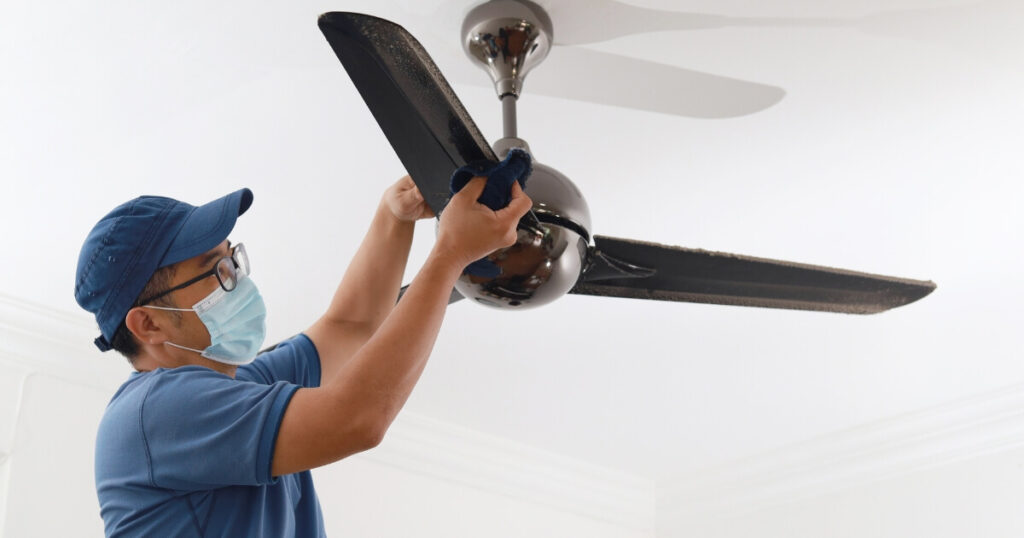
- Dust ceiling fans + light fittings
- Vacuum curtains + upholstered furniture
- Rotate the mattress (helps it wear evenly)
Rotation month 4 — Laundry + storage deep clean (60 min):
- Wash the washing machine (empty cycle with a cup of vinegar or a machine-cleaning tablet)
- Wipe out cabinet interiors (pantry, bathroom cabinet)
- Sort through fridge for expired items
- Wash any items you never wash (throw blankets, cushion covers, shower curtain)
- Restock cleaning supplies + top up the essentials box
Rotate back to month 1 the following month. Everything gets attention 3-4 times a year without a single all-day cleaning marathon.
Quarterly — the forgotten stuff
Once every 3 months, one 2-hour block, tackle the things nobody remembers to clean until they realise they’ve never been cleaned.
- Behind and under the fridge (dust + spillage build-up — pull the fridge out carefully; unplug first)
- Behind the washing machine (lint + water leaks)
- Inside the dishwasher filter (unclip, rinse, replace)
- Window tracks (vacuum first, then wipe with a damp cloth)
- Bin lids (both sides — where lids meet the bin body accumulates grime)
- Kitchen splashback grout (bicarb paste + old toothbrush)
- Doormats — wash outdoor + shake indoor mats
- Air-con filters (pull out, wash, dry, replace — check your unit’s manual)
- The dust bunnies in the corners nobody looks at
This is also the natural time to declutter — one drawer, one shelf, one section of wardrobe per quarterly session. Slow but consistent decluttering beats the “must sort everything” weekend that nobody actually does.

The starter cleaning kit ($40 all in)
You don’t need specialist products. Real basics work for 95% of household cleaning.
- All-purpose spray ($6) — one bottle for surfaces, benches, appliances
- Bicarb soda ($3) — a 500g box lasts months; use for sinks, ovens, grout
- White vinegar ($4) — a 2L bottle lasts a year; use for descaling, mould, hard-water stains, glass
- Dish soap ($6) — kitchen + hand-washing anything
- Toilet cleaner + brush ($15)
- Microfibre cloths x 6 ($10) — colour-code by area (blue for kitchen, red for bathroom, etc.) to avoid cross-contamination
- Sponges x pack of 4 ($6) — replace when they start to smell
Skip: bathroom-specific sprays, kitchen-specific sprays, floor-specific sprays. All-purpose + bicarb + vinegar handles almost everything. Save the money and cupboard space.
For anything that involves scrubbing grout or descaling, add: one old toothbrush (free — repurpose your last one when it retires from teeth duty).
The habits that make it stick
Three small tricks that turn cleaning from a chore into background maintenance:
- Put the caddy in the room, not the cupboard. A cleaning caddy visible in your kitchen means you’ll grab it when you notice a spot. Buried under the sink, you won’t.
- Clean in your worst clothes. Old T-shirt, shorts, socks. Never in “nice” clothes — you’ll subconsciously avoid tasks you might get grimy for.
- Timer, not to-do list. Set a 15-minute kitchen timer and clean until it goes off. Almost always you’ll finish faster than expected. To-do lists trigger dread; timers trigger action.
Why this matters at end of tenancy
Cleaning consistently during your tenancy makes end-of-lease cleaning far easier — but not automatic. Two things worth being clear about.
The maintenance schedule reduces the workload; it doesn’t replace an end-of-lease clean. The mould that took 15 minutes to prevent takes 3 hours to remove. The oven grease that would have wiped off after each cook takes an afternoon of steaming and scraping after two years. Consistent maintenance means your final clean is a top-up session (a solid afternoon), not a lost weekend of remediation.
The legal standard is tied to your ingoing condition report. Under NSW law you must leave the premises in a reasonable state of cleanliness, measured against the condition of the premises documented in your ingoing condition report at the commencement of the tenancy — allowing for fair wear and tear. Agents often scrutinise ovens, grout, window tracks, and exhaust fans specifically. See our guide on what “reasonably clean” means when moving out of a NSW rental for the exact standard, and check your original condition report to see what state each area was in when you moved in.
A note on cleaning products for the final clean. The all-purpose + bicarb + vinegar kit above handles regular maintenance well. For an end-of-lease clean where you have specific stubborn issues — heavily baked-on oven grease, mould in silicone sealant, hard-water staining on shower glass — a specialised product may be worth buying for one use to meet the required standard. Not every clean, just the final one if the general-purpose approach isn’t cutting through.
A note on carpets. In NSW you cannot be required to have carpets professionally steam-cleaned unless it was a specific condition of consent for keeping a pet — see rental decor without losing your bond for the underlying rule. Otherwise the standard is “reasonably clean,” which for carpets usually means a thorough vacuum. Check your condition report: if the carpets were professionally cleaned at the start (some agents note this), you’ll likely need to have them professionally cleaned at the end to match.
Save this schedule
The version of cleaning that works long-term isn’t the deep-cleaning weekend inspired by a Marie Kondo binge. It’s the fifteen minutes today, forty minutes on Sunday, and one focused hour once a month.
Pin this, print it, or set weekly recurring calendar reminders. In three months you’ll know it well enough that the rhythm is automatic and your apartment stays consistently liveable without any single session being a big deal.